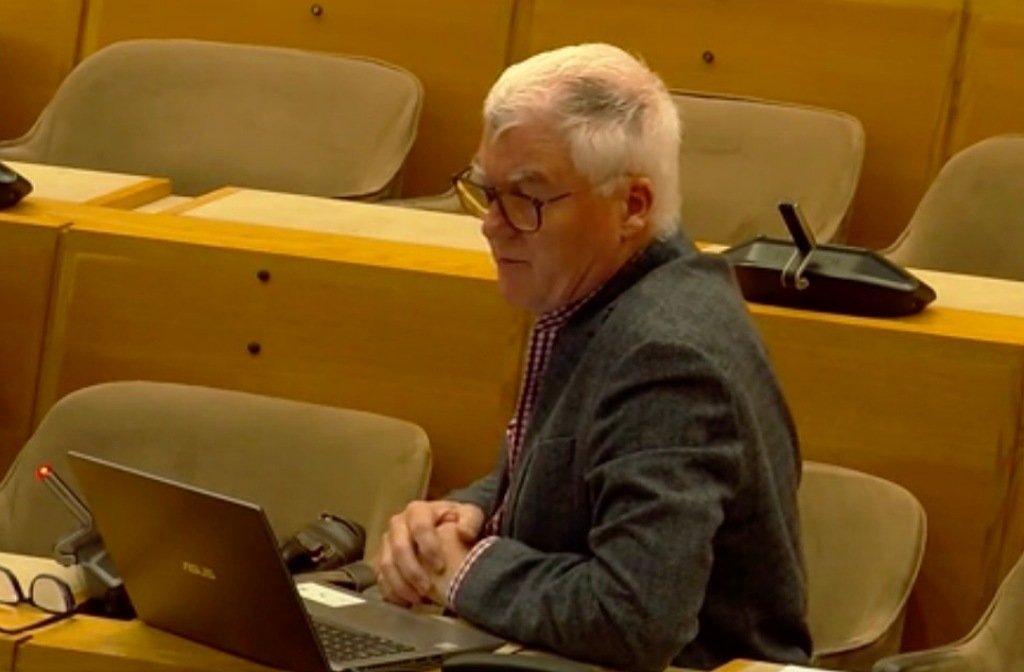
A disagreement over how Bedford Borough Council’s exceptional financial support (EFS) is described sparked heated exchanges at this week’s Full Council meeting, with the Conservative group leader publicly crediting the Bedford Independent as the only outlet that has reported the scheme accurately.
Cllr Graeme Coombes (Wixams), leader of the Conservative group, criticised what he described as “thoroughly misleading reports” elsewhere about the nature of the Government support and whether the council was receiving new funding.

Addressing the chamber, he said a number of broadcasters, politicians and councillors had incorrectly described EFS as a bailout, emergency loan or cash injection from the Government, spreading “misinformation and fake news”.
He contrasted those claims with the Bedford Independent’s reporting, saying this publication was “the only one who so far got it right”, noting our coverage correctly stated that EFS does not provide new grant funding but instead gives permission for a council to use existing resources in different ways.
Read: Government confirms £80m emergency support for Bedford Borough Council
Speaking at the meeting, Cllr Coombes said this misunderstanding had contributed to “fake news” about the council’s financial position and called for clarification on how much EFS had been applied for and how the scheme operates.
They are “all giving out duff information to the public, and don’t appear to know what they are talking about”, he added.
EFS gives ‘breathing space’, not money
Responding, Conservative finance portfolio holder Cllr Marc Frost (Wixams) said EFS was “widely misunderstood”.
“It’s not a loan, it’s not a grant, it’s not borrowing, no cash changes hands,” he told councillors.
“Quite simply, the government allowing us EFS is permission to set a budget that does not balance this year, up to a limit of £22 million, effectively giving us some breathing space this year whilst we stabilise our finances.
“It’s a regulatory permission, not financial assistance and transfer of money.”
He added that any overspend allowed under EFS must still be funded by the council itself, drawing on existing resources, such as reserves, capital receipts, cash flow management or investment liquidation.
Read: Bedford Borough Council has yet to respond to questions about cost and impact of Improvement Plan
He also noted the long-delayed disaggregation funding from Central Bedfordshire Council as a potential source.
“What members need to be clear about is, we are not borrowing £22 million, we are not being lent £22 million, and we have not received £22 million from the government,” he said.
“We are just getting the ability to overspend, if you like, whilst we deliver on those changes.”
‘Honesty needed, not spin’
Former finance portfolio holder, Liberal Democrat cllr Michael Headley (Putnoe), disputed elements of that explanation, arguing the EFS mechanism was already embedded in the approved budget.
“It is not an if, it is a definite requirement,” he said. “There’s a tendency to always try and put the best spin on things.
“The council is in a deep crisis. Being honest with yourselves, being honest with the public, that is the first building block to getting this crisis fixed.”
The debate later touched on comments made by mayor Tom Wootton (Conservative) during a BBC radio interview, in which he likened EFS to “having a credit card”.
Cllr Frost said the mayor had been speaking “jovially” to make the point that no physical cash was involved.
What is Exceptional Financial Support?
The Local Government Association (LGA), the national body representing councils, describes EFS as “exceptionally misunderstood” and often wrongly reported as a bailout.
In guidance to councils, the LGA states, ‘Exceptional financial support has been wrongly reported as consisting of ‘bailouts’ in many parts of the media.
‘This is not accurate. It comprises government permission for local authorities to use existing money in a different way.
‘A local authority that uses asset sales to plug gaps in spending will have fewer assets, and a local authority that borrows additional money to cover gaps in its capital programme will have to repay that money.’
EFS does not provide new funding to councils; it allows them to apply accounting flexibilities to set a legally balanced budget while longer-term recovery plans are put in place.
Bedford Borough Council has been granted EFS in principle for 2026/27 and is awaiting final confirmation of conditions.
Additional reporting by
John Guinn, Local Democracy Reporter