
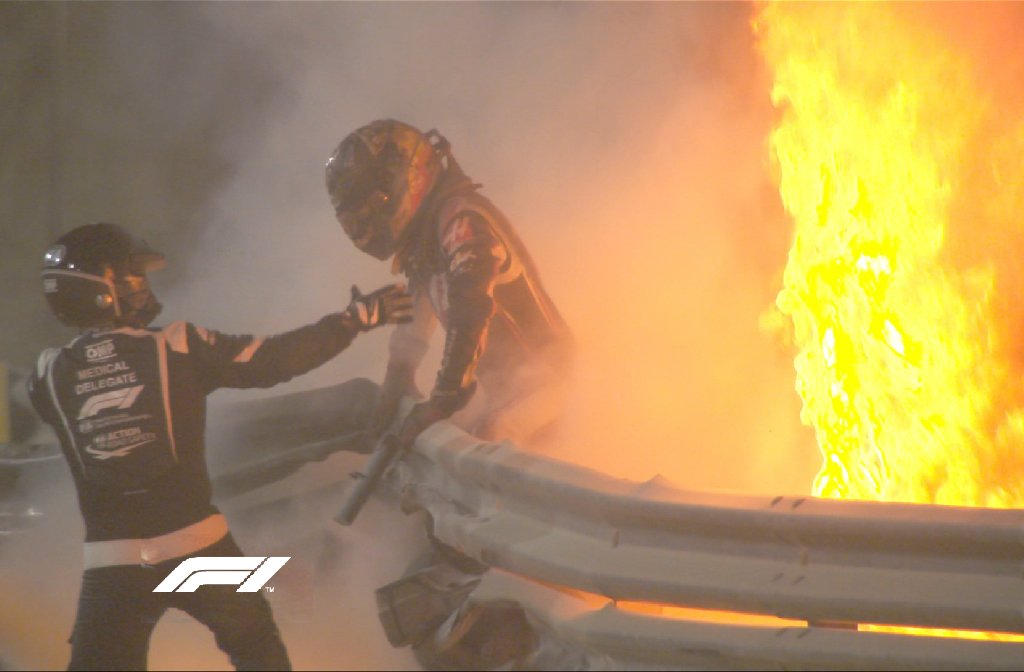
The halo head protection device said to have significantly contributed to F1 driver Romain Grosjean escaping from his burning car at the Bahrain Grand Prix on Sunday, was tested extensively at Cranfield University.
The device was recently introduced into racing cars and is now mandatory in F1 and lower motor racing series.
Viewers were astounded and relieved as they watched Grosjean emerge from a fireball crash following a high-speed impact with a barrier at Sunday’s race.
Incredible images of the crash, and Romain’s escape were shared on the official Formula 1 Twitter feed.
And his escape to safety#BahrainGP #F1 pic.twitter.com/4NJ22yVAPK
— Formula 1 (@F1) November 29, 2020
The halo device was tested extensively at Cranfield Impact Centre in Bedfordshire during its development by the FIA (Federation Internationale de l’Automobile).
It was met with fierce criticism by some who said it would ruin the essence of racing cars and would obstruct the driver’s vision and be visually unappealing.
Since Grosjean’s escape with treatable injuries, support for the halo system has grown.
Cranfield is just one of two FIA-approved test centres in the world
The issue of head protection in motorsport has been investigated in a number of MSc projects at Cranfield over the years.
Dr James Watson, Manager of the Cranfield Impact Centre said: “The halo device, along with other safety features on the latest F1 vehicles, has made a tremendous difference in protecting drivers in accidents.
“In the event of an accident, it is imperative to preserve the survival space around the driver and the halo device forms part of that critical zone.
Prior to the introduction of the halo in 2018, Cranfield conducted compression tests on the device in various scenarios to establish its suitability.
“As with all safety devices in F1 vehicles, the halo is designed to reduce the risk of injury in as many accident types as possible,’ said Dr Watson.
Clive Temple, Motorsport MSc Programme Director and Senior Lecturer at the Advanced Vehicle Engineering Centre, Cranfield University, agrees that halo saved Grosjean’s life
“All of the ‘systems’ in the safety cell of a modern F1 car came into play in this one accident,” he said.
“From the driver’s fireproof clothing and head protection, head and neck support device, to the safety cell structure, impact structures, and, of course, the halo which was critical to Romain Grosjean’s survival.
Cranfield says their Motorsport Master’s courses provide students with an appreciation of the criticality of these systems through taught modules and group design projects.
“Students can go even further by choosing to investigate structures, structural integrity and materials for their individual research projects,” added Clive.
Many of the modern test standards began development decades ago at the Automobile Engineering department, now the Advanced Vehicle Engineering Centre.
“Safety has been at the heart of our performance vehicle engineering for the last 50 years,” said Professor James Brighton, Professor of Automotive Engineering.
“When things go wrong at these high speeds, the consequences would be severe in the absence of the engineered solutions we have today.”
Cranfield University has undertaken research, consultancy and testing for the motorsport sector since the 1970s with their Advanced Motorsport Engineering MSc running since 2000-2001.
it’s the longest running master’s programme covering motorsport engineering and is currently triple accredited by the Institution of Mechanical Engineers, Royal Aeronautical Society and Institution of Engineering and Technology.









