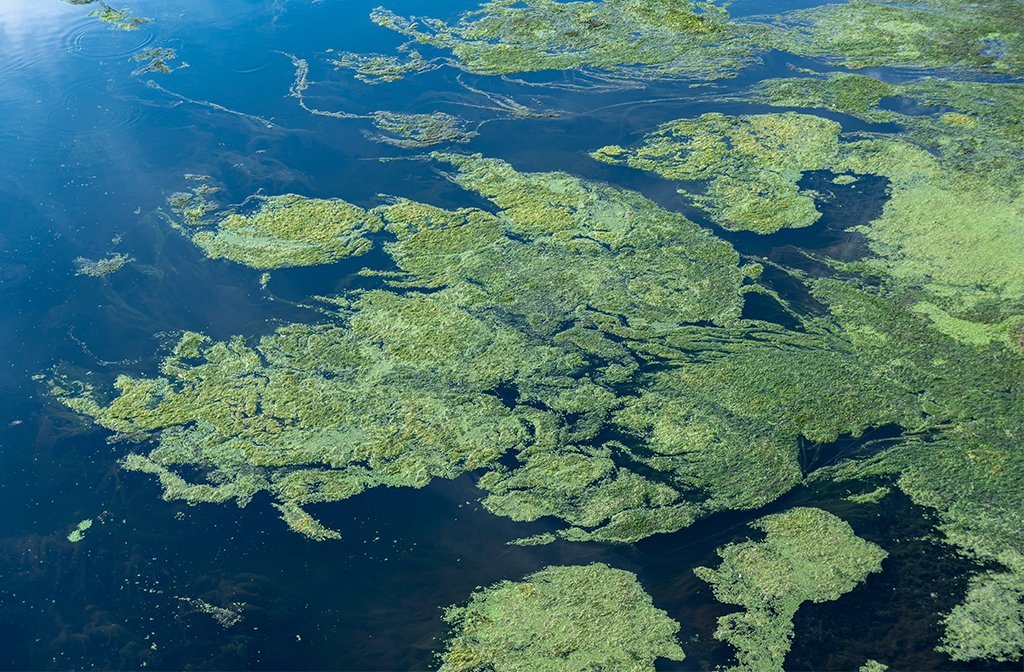
Mayor Tom Wootton (Conservative) has insisted Bedford Borough Council is holding water regulators to account over pollution and toxic blue-green algae on the River Great Ouse, following a period of sustained high temperatures across the borough.
Recent hot weather and low water flow have created prime conditions for algal blooms along the riverbank, posing health risks to local people, dogs, and wildlife.

Standing alongside the river following the recent River Festival, Mayor Tom Wootton shared a video on social media addressing the visible build-up of algae.
He said the council is “not responsible” for managing river water quality, blaming the Environment Agency and Anglian Water instead.
Read: Police called after activists attempt ‘citizen’s arrest’ of Anglian Water CEO
Algae risk
‘Blue green algae can be harmful to people, dogs and wildlife, particularly if they come into contact with or ingest contaminated water,’ Mayor Tom Wootton said in an accompanying statement, adding that protecting the waterway “must be a priority.”
He added that council officers are meeting regularly with the Environment Agency and Anglian Water to push for progress, declaring that the authorities “have got a real tale to tell.”
Adding that, ‘We are holding them to account over our river… We will continue to raise this issue, work with the relevant agencies and press for the action needed to protect our river for Bedford Borough now and for future generations.’
However, the mayor’s latest comments follow previous criticism of his handling of river pollution in Bedford Borough.
He has previously been accused of making “flippant” remarks about pollution in Bedford’s River and describing the role of the newly formed Bedford Borough Water Management Alliance as tracing “where the naughtiness comes from.”
Read: Mayor criticised over “flippant” river pollution comments on eve of festival
The Bedford Independent asked Mayor Tom Wootton directly whether he would now issue a strongly worded demand for Anglian Water to keep local waterways clean and lobby ministers for tougher Environment Agency enforcement powers.
His office failed to respond before our deadline.
Partnership Role
A Bedford Borough Council spokesperson confirmed that national bodies, rather than local government, are primarily responsible for regulating water quality.
“Environmental regulators, principally the Environment Agency, are responsible for monitoring, regulating and enforcing river water quality standards,” the spokesperson said.
The spokesperson added that water companies remain responsible for managing wastewater infrastructure, while the council supports planning, flood risk management, and environmental health.
To tackle elevated levels of E. coli, nutrients, and nitrates, the council established the Bedford Borough Water Management Alliance Partnership, which includes public health bodies, Natural England, and Anglian Water.
Read: New Water Management Alliance to monitor river pollution across Bedford Borough
The council confirmed the strategic partnership will hold its next catchment-wide meeting in September.
Recently, the chair of environmental action group BedsGOVET, Alan Horn, was officially told by Anglian Water that it has no intention of upgrading the Priory Sewage Plant before 2030.
Read: Bedford’s Priory Sewage Plant upgrade ruled out until 2030
The Bedford Independent is currently making enquiries with Anglian Water about a number of leaks in the area and the delay to the upgrades of the Priory Sewage Plant.
So far they have only sent generic responses that do not answer our questions. We continue to pursue specific responses and an interview with a senior member of their management team.
Their response, from an Anglian Water spokesperson, said: “We share our customers’ desire to make our waterways healthier, and as such, we’re committed to making sure that our operations will not be the reason for poor river health.
“That’s why we’re investing £1 billion between now and 2030 to tackle storm spills and improve river water quality, by installing more stormwater storage and preventing rain and groundwater from getting into our pipes to begin with, making storm overflow activations less likely.”
While we are happy to share this response, we have pushed for a specific response to concerns over their sewage discharge and water pipe leaks through an interview with a senior member of their management team.
Official health and safety advice

Despite its name, blue-green algae is actually a type of bacteria known as cyanobacteria that occurs naturally in freshwater environments.
High temperatures, abundant sunlight, and slow-flowing water allow cyanobacteria to multiply rapidly into visible blooms or surface scum resembling paint.
External nutrient run-off from agricultural fertilisers and sewage effluent further accelerates bloom formation during warm summer months.
Certain strains produce harmful toxins that can cause skin rashes in humans and severe illness or death in pets and livestock if ingested.
Algal blooms also block sunlight from reaching aquatic plants and deplete oxygen levels in the water, posing a severe threat to fish and local wildlife.
People and animals can become unwell through contact with water affected by blue-green algae.
People such as paddleboarders, wind surfers, and swimmers who come into contact with blue-green algae scum or accidentally swallow affected water can develop skin rashes, eye irritation, vomiting, diarrhoea, or muscle and joint pain.
These symptoms are usually mild but can be severe in some cases.
Fish caught in waters affected by blue-green algae blooms should not be eaten and should not be fed to pets.
The risk to small animals like dogs is significant over the summer months as they tend to drink more water in the heat and may eat shoreline crusts of algae. Dog owners should prevent their pets from coming into contact with affected water.
The Environment Agency has also urged the public to follow safety advice from the UK Health Security Agency when interacting with open water.
Official guidance states that anyone touching the river should cover all cuts, scratches and open sores with waterproof plasters before entering. People must avoid swallowing river water or splashing it into their mouths.
People are also advised to thoroughly wash their hands with soap and water after any contact with the river and before handling food.