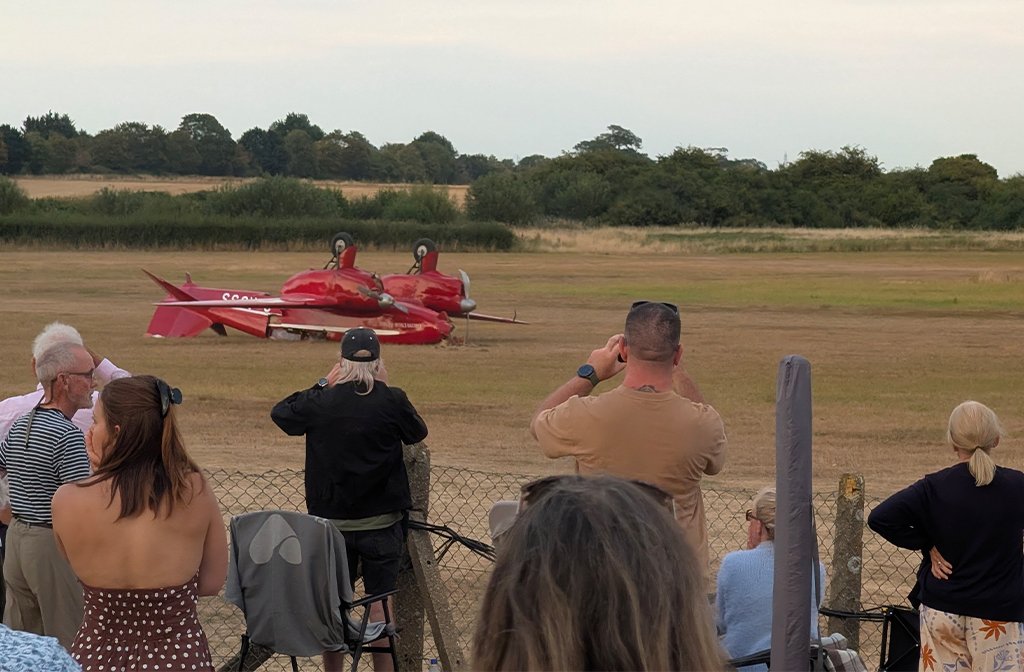
The world’s only airworthy De Havilland DH.88 Comet Racer (G-ACSS) ‘Grosvenor House’ was badly damaged during an airshow at Shuttleworth’s Old Warden Aerodrome, near Bedford, on Saturday (15 August)
Initial reports suggest that the bright red 1930s air racer was making a second landing attempt on Old Warden’s grass runway, during the Shuttleworth Collection’s Flying Proms Air Show.

According to eyewitnesses, G-ACSS overran the landing strip at around 7.20pm, braked sharply, became tail-heavy, nosed over and inverted. Bedfordshire Fire and Rescue crews quickly extracted the single pilot.
The pilot was later discharged from a local hospital after overnight observation. No spectators were injured, and the air displays continued.
On 16 August, the Shuttleworth Collection, which operates ‘Grosvenor House’, posted a statement on X, “We would like to thank all of the staff, volunteers and emergency services for their dedication and support during and beyond the incident.”
Updates on the aircraft will be released after the UK’s Air Accident Investigation Branch (AAIB) concludes an examination.
But local photographs suggest this flying legend, built in Hatfield and the world’s only airworthy DH-88 Comet, has suffered serious damage.
Air racing legend
G-ACSS ‘Grosvenor House’ has been part of the Shuttleworth Collection in Bedfordshire since 1965.
It is a regular crowd pleaser at the Collection’s summer weekend shows, which combine vintage air displays with a live orchestra.
It is one of only five built at the de Havilland Company factory in Hatfield, Hertfordshire. ‘Grosvenor House’, named after the Grosvenor House Hotel in London.
This two-seat, enclosed-cockpit, wood-and-metal streamlined beauty (designed by A.E. Hagg) made its first flight in 1934 for the 11,300-mile MacRobertson Air Race from England to Australia.
Weighing 5,550 lbs and powered by two 230hp Gipsy Six R engines, it was capable of a maximum speed of 220 mph. It was the first de Havilland aircraft with a retractable undercarriage and variable-pitch propellers.
It featured a state-of-the-art stressed-skin fuselage. The sleek DH-88 Comet Racer was built not just for speed but for range: some 3,000 miles on three large fuel tanks.
It had a maximum flight ceiling of 19,000 feet. ‘Grosvenor House’ soon became an icon of Art Deco modernity.
In October 1934, flown by pilots C. Scott and T.C. Black, and competing against two other Comets, it memorably won the England-Australia race.
The course time was 70 hours, 54 minutes,18 seconds. The DH-88 was built for air racing above all else. Pilots over the years have described it as challenging to fly and, more particularly, to land.
Like many vintage aircraft worldwide, ‘Grosvenor House’ has been involved in accidents over the years.
In 1936, whilst serving with the RAF, it experienced a serious landing accident but was rebuilt by 1938 for further racing.
After the Second World War, ‘Grosvenor House’ went on static display at the 1951 Festival of Britain exhibition on London’s South Bank before the Shuttleworth Collection acquired it in 1955.
In 1987, the Collection restored it to full flying condition. It suffered an additional air accident in October 2002 when its right undercarriage collapsed on landing.
After that, the Collection modified and re-certified ‘Grosvenor House’ as airworthy in 2014.
Torrid summer
Ground photographs from Old Warden this weekend showed ‘Grosvenor House’ on its back, with visible damage to its tail assembly (marked with the number 24, indicating the date of its maiden flight).
There is possible damage to its cockpit, horizontal stabilisers and to its twin Gipsy Queen II engines. 2026 is proving a torrid summer for British vintage aviation, with concerning crashes.
The Comet crash is the second incident at Old Warden this display season.
On 30 May, an Avro Triplane IV replica, flying two Union Flags from its interplane struts, crashed into trees at the Shuttleworth Collection’s Wings and Wheels display.
24 hours after the Comet accident, a Druine D.31 Turbulent Team light aircraft also crashed during a low-level display at the Stow Maries Great War Aerodrome in Purleigh, Essex.
Rebuild
In a statement on social media today (Tuesday), the Shuttleworth collection said: ‘Following the incident at our Flying Proms Air Show (15.08.2026), we can confirm that The Shuttleworth Trust intends to rebuild the de Havilland DH.88 Comet to airworthy condition.’
Update: We updated this article at 20:58 on 18 August 2026 to include the Shuttleworth Collection’s update on plans to rebuild the DH 88.