

A much-loved Bedford dad and teacher who devoted his life to helping young people has died after an eight-year battle following a devastating stroke.
Now his daughter is sharing his story to honour his memory and help others spot the signs of stroke earlier. Bedford’s Tony Boatswain died on 09 January at the age of 63, leaving behind his wife, three children and three sisters, including a twin.

His daughter, Brogan Kowal, described him as “our gentle giant” and said there are few people in Bedford who did not know him.
Gentle giant
“My dad was just such a… we called him a gentle giant,” said Brogan.
“He was really big in stature, you know, over 6 feet, but also just the biggest heart, if I’m being honest, and there aren’t many people in Bedford who probably don’t know my dad.
“He was a teacher for many years across different schools in Bedford, and he played football for many years, coached teams and did a lot of work in the community.
“When I think of legends in Bedford, you know, we have Paula Radcliffe and Tom Grennan. It’s funny, but I also think of my dad.
“Walking down the High Street with him when I was a child was nearly impossible because we would not get far before we saw somebody who knew him and just wanted to speak to him.
“He would always stop and have time for other people and just, yeah, a really kind, gentle person.”
Tony spent many years teaching in Bedford, including as deputy head at Grey’s Education in Kempston, working with young people who had been excluded from mainstream school.
“A lot of them felt almost given up on, and my dad would never give up on them,” said Brogan.
“He would always try and let them see the potential in themselves and direct them on the right path. He did a boxing club at the weekends for a lot of them just to keep them out of trouble and give them a bit of structure and something to do.
“After he got ill, he would still be in touch with some of the boys that helped run it, and I know that meant a lot to him that it kept going.”
“Such a fighter”
Tony first became unwell in 2018. He began having migraines at work and did not feel himself. As a diabetic, he thought it might be linked to a change in insulin or his blood sugar levels.
After a visit to his diabetic nurse, he went to his GP, but was misdiagnosed and sent home with antibiotics for what was thought to be an infection.
“When my dad left the GP, he actually could not see properly; his peripheral vision had gone,” said Brogan, “He was a safe driver and never had an accident, but he ended up crashing into a stationary vehicle because he could not see.”
That night, his condition worsened.
“In the middle of the night, he called everyone because he did not feel well, but because it was the middle of the night, no one answered,” said Brogan.
“It was not until about 3am my auntie, his twin sister, picked up. He said, ‘I have dropped a glass, and I cannot see to pick it up,’ and he was really confused. She just knew straight away something was wrong and called an ambulance.
“He was rushed straight to hospital and it was confirmed he had had a stroke. His face had dropped, and he had a bit of slurred speech.”
At first, the family hoped he might recover quickly, but his condition deteriorated, and he was transferred to a London hospital.
“We were told he probably does not have much chance of survival, but the doctors wanted to operate to give him that chance,” said Brogan.
Tony had serious swelling on his brain and needed emergency surgery to remove part of his skull to relieve the pressure.
“It was very invasive and serious surgery, and we were kind of told the worst,” she said, “But again, my dad is such a fighter, such a warrior. The next day, we were told, no, he is awake, he is out of his coma.
“It was a really long journey. He was in hospital for maybe six to eight months and then he went to a rehabilitation centre. Day by day he kept defying the odds.”
Eventually, Tony returned home and, with support, was able to rebuild some quality of life.
Although he lost much of his independence and was paralysed down one side after the stroke, Brogan says he never lost his humour or his positive outlook.
“He was very humorous, very cheeky,” she said.
“You almost grieve the person they were, but you are also so appreciative they are still here. He gave us nearly eight more wonderful years after his stroke, which he should not have even survived.”
Friends continued to treat him “normally”, arranging wheelchair taxis so he could still go out for meals and socialise.
“They would do loads of things with him and just, yeah, they treated him normally, and I think my dad really appreciated that,” said Brogan.
Saying goodbye
As the years went on, Tony’s health became more fragile. He was in and out of hospital, and when his wife became seriously ill, he moved into a care home.
“In the last year, my dad had been in hospital nearly 30 times, and that is just not a quality of life you would want anyone to have,” said Brogan.
Over Christmas, he spent almost three weeks in hospital. He was due to be discharged, but the care home felt unable to meet his increasingly complex needs.
“When we told him that, he cried,” said Brogan.
“He just said, ‘I feel I am going to die in this hospital,’ and that is such a horrible thing to have to think about.
“Unfortunately, he then got sepsis in hospital, and there was nothing they could do. His body had just been through too much, but he had also been through enough.”
Tony died on 9 January.
“It is probably the hardest thing that has ever happened to me,” said Brogan.
“But the only peace I try and find now is that he is no longer in pain, he is no longer suffering. That is almost comforting at this time.”
Turning pain into power
After Tony’s stroke, Brogan decided she wanted to do something positive in his name.
She began fundraising for the Stroke Association and has already run two marathons, in 2021 and 2023, raising around £5,000 for the charity.
The family also asked for donations to the Stroke Association in memory of Tony, and Brogan hopes to secure another marathon place this year.
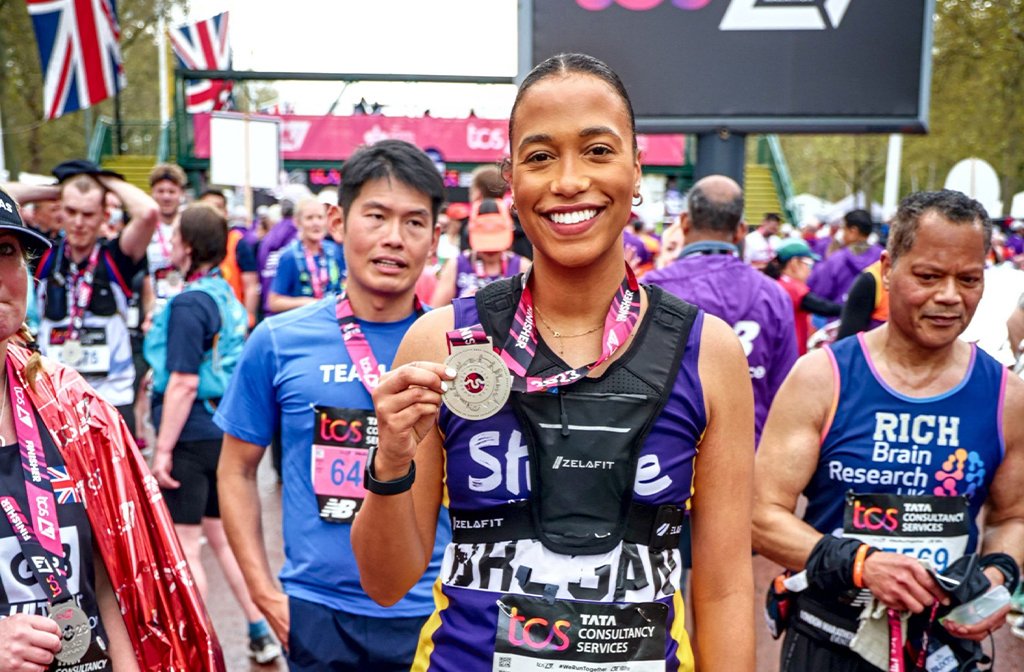
“It was so empowering, and it just made me want to continue to do more,” she said, “For me, it is important to carry my dad’s legacy on, the impact he left on this earth.
“Grief is hard, but this is a way to help me turn that pain into power and really honour my dad and everything he did in his life.”
Tony had also spoken to the charity about his experience.
“He said if his story or his advice helps one person, then it is worth a thousand words,” said Brogan.
“That just really sums up the kind-natured person that he was and how he always continually wanted to help others, even though he was unwell himself.”
Brogan now uses her platforms to talk about stroke symptoms and prevention. One friend later told her that, because of what she had shared, she recognised the signs in a stranger on a train and was able to get help.
“Stroke does not discriminate. It can affect anyone, any age, any background,” said Brogan, “Know the signs, know the symptoms. Do not be embarrassed to learn more and share that knowledge.”
Stroke risk rising
The Stroke Association warns that, without urgent action on prevention and care, almost 414 people a day could have a stroke in the UK by 2035, around one person every three and a half minutes.
Currently, about 280 people have a stroke every day. Stroke is already the fourth leading cause of death in the UK and leaves many survivors living with long-term disability.
As the population ages and more people live with conditions such as high blood pressure, the charity says the risk is rising. High blood pressure is linked to around half of all strokes.
The Stroke Association is urging people to reduce their risk by:
- Having regular blood pressure checks with a GP or pharmacist, or using a home monitor
- Eating a healthy, balanced diet
- Not smoking or vaping
- Being physically active
- Avoiding excessive alcohol
- Attending NHS Health Checks when invited and acting on any advice given
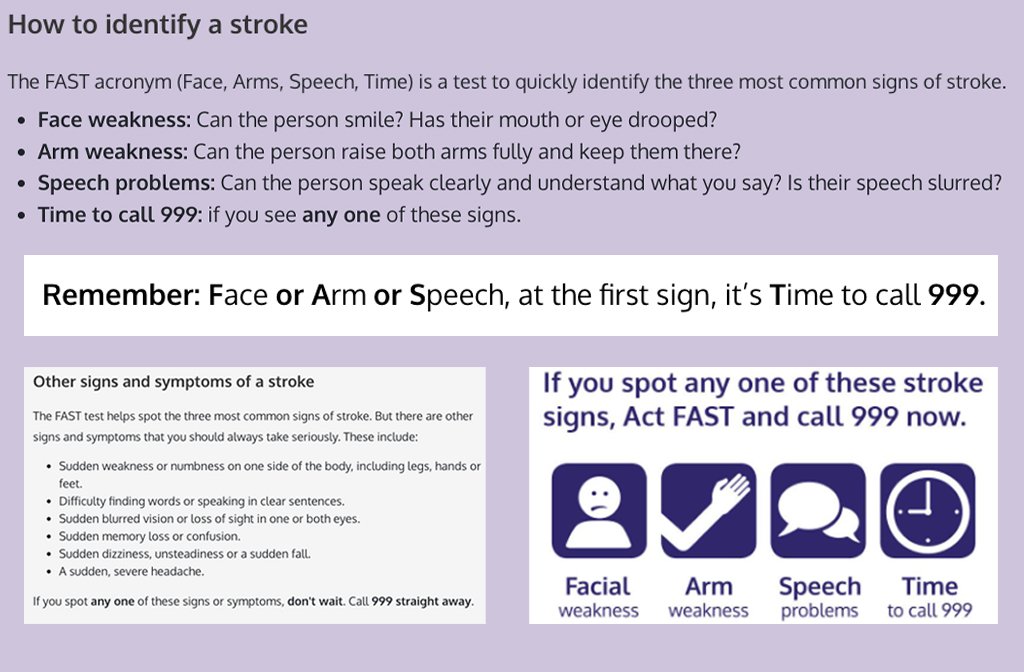
How to identify a stroke
The FAST acronym (Face, Arms, Speech, Time) is a quick test used to identify the three most common signs of stroke.
- Face weakness: Can the person smile? Has their mouth or eye drooped?
- Arm weakness: Can the person raise both arms fully and keep them there?
- Speech problems: Can the person speak clearly and understand what you say? Is their speech slurred?
- Time to call 999: if you see any one of these signs.
Remember: Face, Arm, or Speech. At the first sign, it’s Time to call 999.
The charity is also calling on the government and the NHS to put more emphasis on prevention and support for stroke survivors, including better follow-up after a first stroke to reduce the risk of another.
For Brogan, the message is simple.
“Once you know the symptoms and the signs, you cannot forget,” she said.
“If what we have been through helps even one family get help faster, then that is something my dad would be incredibly proud of.”
Anyone affected by stroke can visit stroke.org.uk or call the Stroke Association’s dedicated Stroke Support Helpline on 0303 3033 100 for information, guidance or a chat when times are tough.









