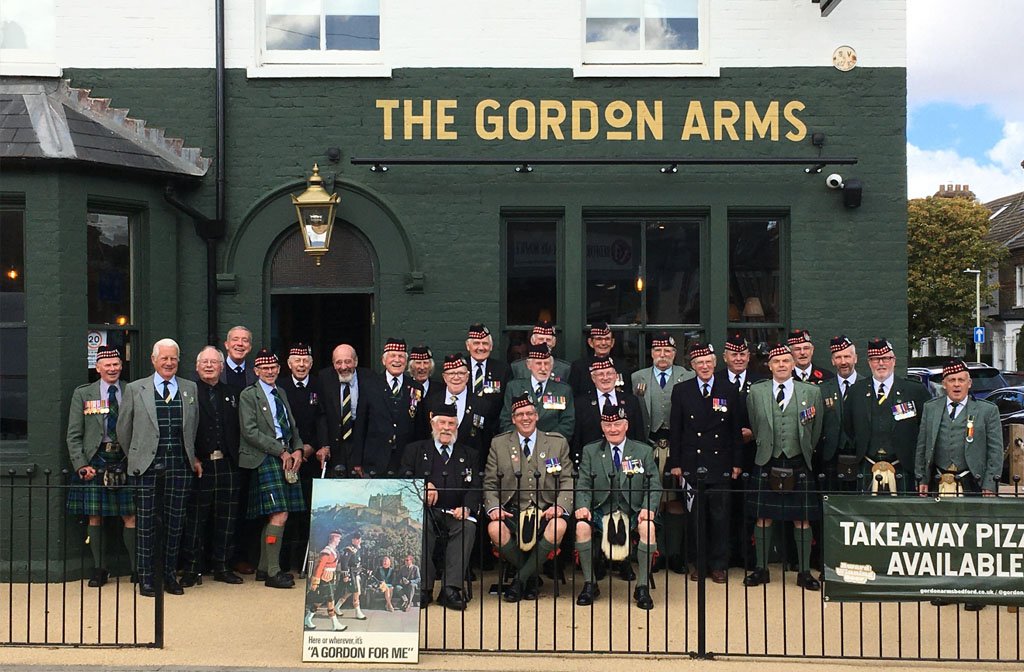
Thirty members of the Gordon Highlanders Association from Aberdeen were given a warm welcome when they visited Bedford this month.
In 1915, Bedford played a significant role in the Scottish Highland Division’s preparations for active service in the first nine months of World War One when they were billeted here.
The visit was the first part of a weekend pilgrimage which also saw the Division’s veterans paying their respects at the Regiment’s memorial in the National Arboretum in Staffordshire.
During their time in Bedford, the visitors spent the morning at the Gordon Arms on Castle Road, a venue that has a very strong link with the Highland Division’s story.

Local historian Richard Galley presented an illustrated talk about the Highland Division’s time in Bedford and the impact that this friendly invasion had on the town.
“Given the fact many of these brave men had travelled all the way from Aberdeen to be here, topped with all the history behind it, we deemed it crucial to recreate the historic photo from the start of World War 1, over 100 years ago,” said Daniel Hicks from the Gordon Arms.
“We were able to achieve a comparable ‘Then & Now’ post to show our lovely community the rich history we have at our doorstep and most importantly to pay our respects to them and those before them.
“The team and I would just like to say thank you to everyone who made the journey down, it was a memorable day to say the least and we greatly look forward to your return.”
After lunch, the veterans visited Foster Hill Road Cemetery where they were welcomed by Bedford Pipe Band.

The visitors held a moving ceremony to pay their respects to the Highlanders who are buried in the Cemetery having fatally succumbed to disease in the winter of 1914/15.
The visit to the Cemetery ended with tea generously provided by the Friends of Bedford Cemetery.
Historian, Richard Galley, said, “The visit had been several months in the planning and it was a privilege to be able to play a part in making it happen.
“It was a truly memorable day. The Gordon Arms provided the perfect venue and the weather couldn’t have been kinder when we visited the Cemetery.
“I’m immensely grateful for the help and support given by Bedford Pipe Band, the Friends of Bedford Cemetery and our local Royal British Legion standard bearers.
“The visitors were undoubtedly bowled over by the warmth of the welcome they received from everyone they met and the hospitality shown to them, perfectly mirroring the experience of the Highlanders who came to Bedford 108 years ago.”
Historical background
During the first nine months of WW1, 3,000 men of the Gordon Highlanders were stationed in Bedford as part of the Highland Division which numbered some 22,000 when it left the town for the Western Front in May 1915.
The vast majority of these soldiers were billeted in the town centre and mostly within households.
The bonds that were forged between the Highlanders and Bedfordians were immensely strong and particularly enduring.
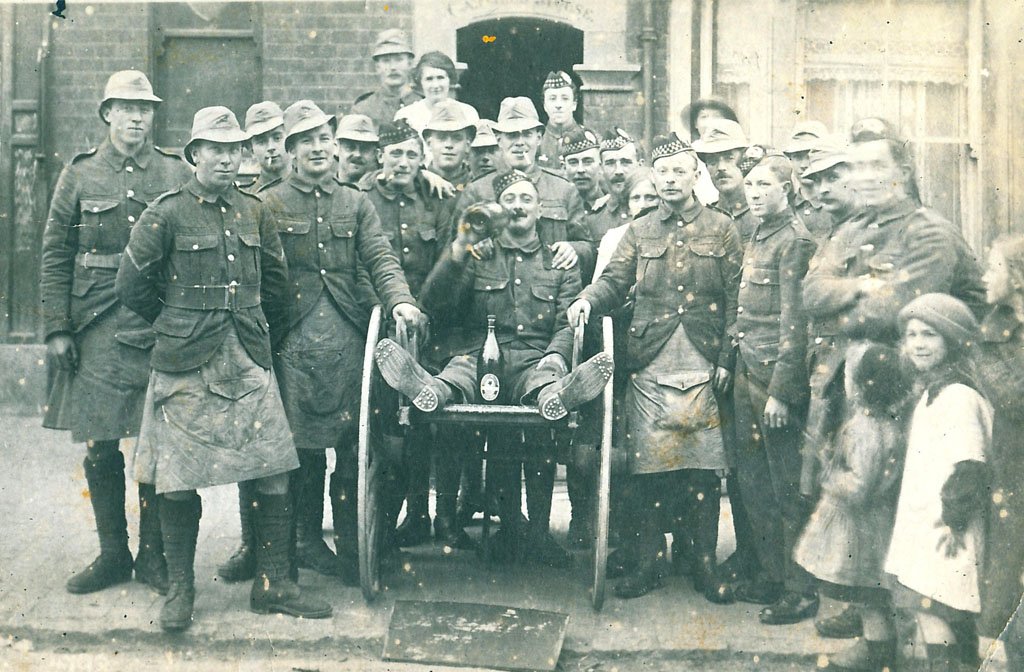
Bedford’s Mayor, Harry Browning, was influential in setting-up the Borough Recreation Committee for the Troops which did such sterling work in providing for the soldiers in their off-duty time.
The Division suffered badly from the effects of disease (measles, scarlet fever and diphtheria) during the winter of 1914/15 and a number of men died, 33 of whom are buried in Foster Hill Road cemetery. 14 of these men were Gordon Highlanders.
The Gordon Arms was frequented by men of the Argyll and Sutherland Highlanders whose billeting district took in the area bounded by The Embankment / Russell Park, Goldington Avenue, St Cuthberts and Newham Avenue.
What is now the Ent Shed is thought to be the sole surviving recreation hall constructed by the War Office for use by the Highland Division in the winter of 1914. There were several of these large wooden buildings erected in the billeting districts dotted around the Town.