by Dan Fattorini
If you travel around Bedford’s surrounding countryside you will rarely see farmland put aside to anything other than arable farming with the bright yellow fields of rape in the spring and the golden waves of wheat in summer. We’re therefore not really known for our dairy production yet we do actually have very good conditions to produce milk. North Bedfordshire is home to several dairy farms, one of which I went to visit recently to collect ingredients for a home dairy making session.
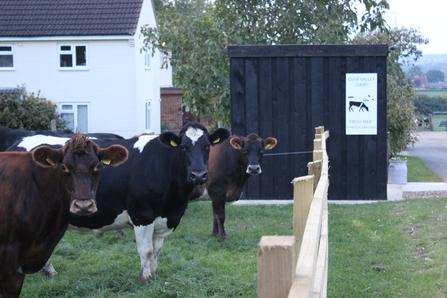 Ouse Valley Dairy sits just outside Carlton and is home to an impressive herd of Jersey-Friesian crossed cattle. These cows are free to roam the grass leys of the Ouse floodplain which is a mixture of grass and white clover. The latter of these has been shown to produce milk more rich in Omega 3 making it nutritious as well as enhancing the taste. The mix of the two breeds seems to be a perfect compromise between the rich golden milk of the Jersey cows with the higher yield of a Friesian. Just looking at the milk you can see it is a great product with a noticeably golden colour.
Aside from being home to great milk, Bedfordshire has also traditionally been home to many Italians. Mozzarella with its creamy taste and versatility is a genuine staple of Italian cuisine. Being an easy cheese to make it would have been most commonly produced at home years ago. It’s actually probably more correct to call it a processed curd than a cheese as it’s made in a very different way to most cheeses. Here are the steps to make your own at home. I used unhomogenized milk from Ouse Valley Dairy which is less processed but standard full fat milk will do.
Ingredients:
5 litres of full fat milk (unhomogenized preferable but not essential)
150ml cold tap water
1 teaspoon of salt
1 ½ teaspoons of citric acid
10 drops of liquid rennet
Citric acid and rennet are available from health food shops or online
Equipment:
Cooking thermometer
Large pan (to fit 5 litres)
Long knife
Slotted spoon
Rubber gloves
Microwavable Bowl
First take 100ml of the water in a cup and stir in the citric acid, then put the remaining 50ml in a cup and stir in the rennet.
In a large pan combine the milk and the citric acid solution. While carefully checking with the thermometer, warm the milk to 30 degrees Celsius. Once approaching the right temperature be careful not to overheat as the milk can still warm up from the residual heat of the pan. Try turning off the heat when one or two below the target temperature letting it rise up or gently heating to the target temperature.
Once at temperature add the rennet solution and stir well immediately. Then put a lid on the pan and leave for five mutes. After this time the milk should have formed a thick curd that resembles set yoghurt, if it hasn’t quite reached this consistency you can mix up another few drops of rennet with water, stir again and wait a little more for it to set.
At this stage you need to cut the curds by carving a grid using the long knife to the bottom of the pan then carving diagonally to break it all up. Once you have done this you can start heating the mixture again, this time to 40 degrees Celsius. Once at this temperature you can start separating the curds into the microwavable bowl with a slotted spoon. You may need to drain them twice to expel the remaining whey.

Now transfer the curds to a microwave and heat gently to 57 degrees Celsius, checking every 30 seconds by probing with the thermometer. Once at this temperature, remove from the microwave, sprinkle over the salt and wearing rubber gloves knead the curds like you would bread dough. You should feel it coming together like stringy dough. It might be quite messy so place the tea towel under the board beforehand. If you want a soft salad mozzarella then don’t over knead, more kneading will give you a better cooking cheese with a little less water.
The name Mozzarella comes from the Italian word to cut. So once kneaded roll into a fat sausage, shape and cut the sections off before rounding them into little balls. Your cheese is ready to eat! It will keep for several days and you can extend its shelf-life by making brine with 1 litre of water and 80 grams of salt. The cheese can be stored in the resulting brine for up to a week.
This recipe is for a clean un-cultured mozzarella, a thicker more characterful version can be made by adding bacteria to the milk a day or two before. To try this and other exciting crafts in Dairy, Charcuterie and more, please sign up and come along to our Beyond Cookery Classes on Thursday evenings twice a month at Rogan’s Books.
Ouse Valley Dairy milk and cream is available at Foods of Italy, Summerhill Farm Shop, Browns of Stagsden, Woburn Country Foods, Scald End Farm Shop, Franklins of Thorncote, Frosts Food Hall and Milton Ernest Garden centre.