
From illegal surveillance to economic pressure, media monopolies to SLAPP lawsuits, the UK might not be quite the bastion of press freedom it claims to be.
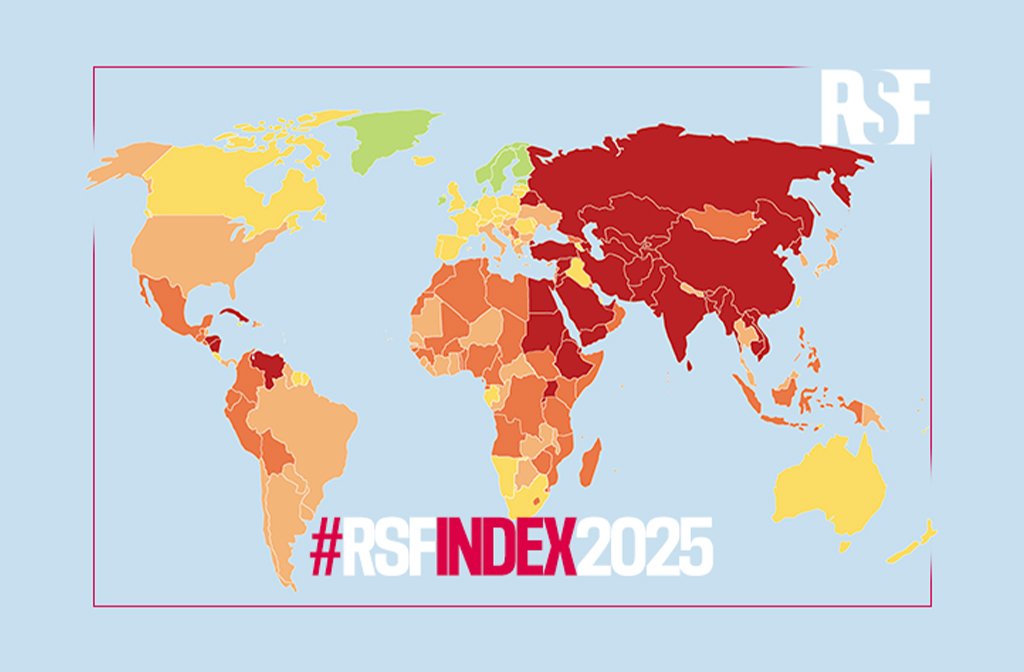
According to the 2025 World Press Freedom Index by Reporters Without Borders (RSF), the UK has risen slightly to 20th place, up from 24th last year.

But the rating is still only ‘satisfactory’, and Britain ranks behind Estonia (2nd), Ireland (8th), Germany (11th), and even Czechia (10th).
The top-ranking country is Norway, in first place for the ninth year running. Eritrea is ranked at the bottom of the list at 180th, where journalism is entirely state-controlled and dissent is silenced.
The United States, meanwhile, dropped two places to 57th, with press freedom deteriorating under Donald Trump’s second term, the closure of local media, and widespread disinformation.
RSF’s 2025 report reveals a broader crisis for journalism. The economic indicator in the global index is at its lowest level ever.
The profession is increasingly fragile, caught between financial precarity, rising violence, state interference, and the dominance of tech platforms over ad revenue. Since January 2025, 15 journalists have been killed and 532 remain in detention worldwide.
Don’t, however, confuse press freedom with being able to say whatever you like. Freedom of expression is vital, but it must be balanced with responsibility.
A truly free and fair society has legal safeguards to prevent hate speech, incitement to violence, and the spread of dangerous misinformation.
Read: Why press regulation matters: A guide to how UK journalism is held to account
This is why proper press regulation is essential, but it should work hand in hand with safeguards that protect journalistic freedom and public interest reporting.
Press freedom should guarantee that journalists can investigate, question, and report on matters of public interest without fear, interference, or persecution.
Read: Police investigating as Bedford Independent receives death threats
The UK’s media landscape: who really controls the news?
In the UK, concerns range from government policy to private influence. While journalists are generally able to operate safely, RSF describes the country’s press freedom landscape as marred by:
- Alarming attacks on Iranian journalists exiled in the UK
- The rise of SLAPPs – lawsuits designed to intimidate or silence critical reporting
- A dangerous concentration of ownership – three companies (News UK, Reach, and DMGT) dominate the national newspaper market
- Budget cuts and job losses across the industry
- Low public trust in the media
While the BBC continues to provide critical public service reporting, it faces sustained political pressure. Meanwhile, journalists face threats at protests, online abuse, and little government action to defend their safety.

As Anne Bocandé, RSF’s editorial director, put it, “Without economic independence, there can be no free press. When journalists are impoverished, they no longer have the means to resist the enemies of the press — those who champion disinformation and propaganda.”
The latest round of Local Democracy Reporter Scheme (LDRS) contracts is a recent example of these issues playing out in real time.
Despite the BBC claiming they had ambitions to diversify the scheme, more than half of all contracts were again awarded to Reach PLC — already one of the UK’s largest publishers.
While the scheme plays a vital role in holding local authorities to account, critics argue that this continued concentration of funding and influence undermines genuine media plurality.
It reminds us that even publicly funded journalism can reflect the same centralised ownership structures that weaken press freedom.
A growing movement: independent journalism in the UK
Despite these challenges, there’s hope.
The rise of independent, community-based journalism in the UK has strengthened public interest reporting.
Titles like The Ferret, Manchester Mill, Shetland News, Bristol Cable and those from Progress Publishing (including this paper, the Bedford Independent and Bedford Clanger) are part of a growing movement of accountable, transparent, locally rooted newsrooms.
Organisations like the Independent Community News Network (ICNN) and the Public Interest News Foundation (PINF) champion these titles and lobby for better recognition and support.
Impress, the UK’s only Leveson-compliant press regulator, often regulates these publications, which promotes high standards of accuracy, ethics, and accountability.
These titles often serve areas abandoned by traditional publishers. They offer in-depth local reporting, hold local power to account, and build trust in ways national outlets sometimes fail to do.
Progress Publishing, for example, has:
- Grown its readership to over 130,000 unique users per month across its digital platforms.
- Built the Bedford Independent as one of the most-read independent news websites in the East of England.
- Used its Facebook group ‘We Are Bedford’ (with over 86,000 members) to promote accurate community information and counter misinformation.
- Maintained coverage of the positive things happening on its patch, including a regular What’s On Guide and sports coverage
These successes show that trust can be rebuilt, one story at a time — even in a landscape dominated by conglomerates and financial pressure.
Read: From Kyiv to Bedford: Why local journalism matters
Why this matters
Read: DCMS Committee warns Government must act to halt decline of local journalism
At a time when news is increasingly shaped by algorithms, billionaire owners and unchecked AI-driven content, the public’s access to reliable, independent journalism is more vital than ever.
Press freedom is not just about whether journalists can do their job without fear of violence or censorship. It’s about whether the public is truly informed, whether different perspectives are heard, and whether truth is protected from distortion.
For the UK, this means protecting journalists and the conditions that allow them to thrive.
It means tackling ownership concentration, funding public interest journalism, backing regulation with teeth, and defending local media as part of our democratic infrastructure.
For readers, this means supporting those doing the work by subscribing, sharing, donating, and reading widely.
Free press is never a guarantee. It’s something every democracy has to work at, and something no democracy should take for granted.
This article is part of a series of articles to help support media literacy.









